Signal authorization
01Who is asking, and what are they allowed to see?
- Identity and role resolved from authority context
- Permitted sources confirmed; denied sources removed
- No query sent to any restricted system
Enterprise Context Fabric
A haywire AI agent doesn’t misbehave because the model is bad. It misbehaves because nothing governed what it was allowed to know, do, or prove. The Fabric is that governance layer—and it runs before the agent touches anything.
See how it worksHow the Fabric works
At each layer, the Fabric narrows raw enterprise signals into the minimum trusted package. The agent arrives oriented, scoped, and bounded.
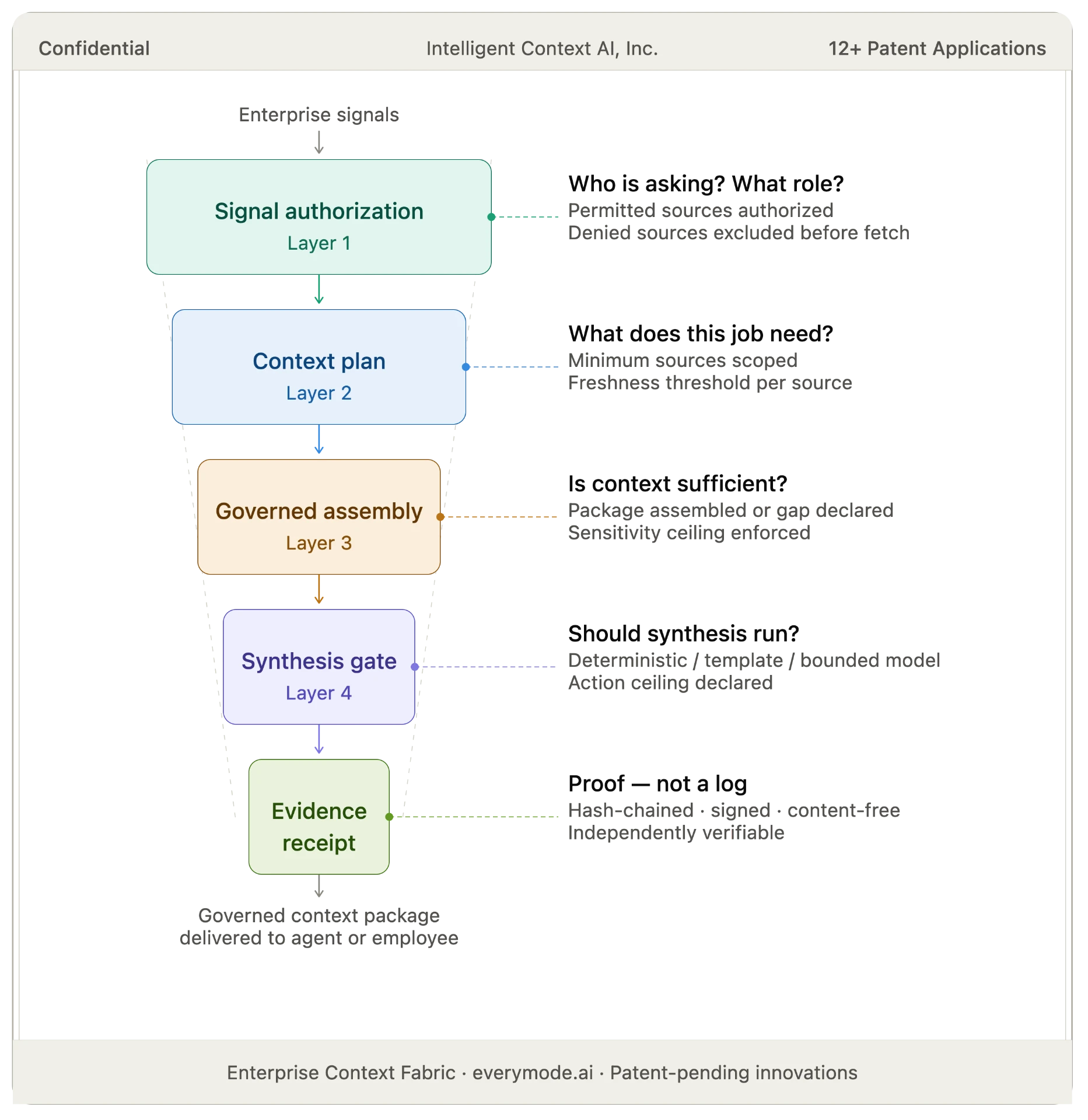
Enterprise signals
Who is asking, and what are they allowed to see?
What does this job actually need?
Is the context sufficient, and is it clean?
Should the model reason over this, and how?
What happened, and can anyone prove it?
Governed context package → agent
The agent never touches a system it is not authorized to reach. Permission enforcement happens before retrieval, not after.
zero unauthorized source queries
The Fabric assembles only what the job requires instead of searching broadly and discarding most results.
one governed package, not a scatter search
Minimum sufficient context means less sent to the model, lower cost per call, and more focused output.
minimum context in, minimum tokens billed
Explicit evidence gaps and relevant context leave the model less room to confabulate.
gaps named—never guessed
Every interaction records what was authorized, denied, and done in an independently verifiable artifact.
signed · hash-chained · content-free
The evidence trail
When an ungoverned agent goes wrong, there is no artifact answering what it could access and what it did. The Fabric produces a content-free cryptographic receipt for every governed interaction—hash-chained, signed, and independently verifiable.
Sample receipt · synthetic data
job_type customer_renewal
sources_allowed crm, email, support, contracts
sources_denied finance_tier3, phi, other_accts
sufficiency met · sufficient_for_draft
action_ceiling read_only · no_write
content_in_receipt false
signature ed25519:7f2a…b8c3
See the architecture in a live synthetic demo—no login, no real data, ten minutes.
See the live demo